There and Back Again Lewis and Clark

Road of the expedition on a map with modern borders
The Lewis and Clark Expedition from August 31, 1803, to September 25, 1806, likewise known every bit the Corps of Discovery Expedition, was the United States expedition to cantankerous the newly acquired western portion of the state after the Louisiana Purchase. The Corps of Discovery was a select grouping of U.Due south. Army and noncombatant volunteers under the command of Captain Meriwether Lewis and his close friend Second Lieutenant William Clark. The expedition fabricated its way west, and crossed the Continental Divide of the Americas before reaching the Pacific Coast.
President Thomas Jefferson commissioned the trek shortly after the Louisiana Purchase in 1803 to explore and to map the newly acquired territory, to find a practical road across the western one-half of the continent, and to establish an American presence in this territory earlier European powers attempted to establish claims in the region. The campaign's secondary objectives were scientific and economic: to report the area's plants, animate being life, and geography, and to establish trade with local Native American tribes. The expedition returned to St. Louis to report its findings to Jefferson, with maps, sketches, and journals in paw.[i] [2]
Overview
One of Thomas Jefferson'southward goals was to find "the most direct and practicable water advice across this continent, for the purposes of commerce." He too placed special importance on declaring US sovereignty over the land occupied by the many different Native American tribes forth the Missouri River, and getting an accurate sense of the resources in the recently completed Louisiana Purchase.[three] [4] [5] [vi] The expedition fabricated notable contributions to science,[7] only scientific research was not the main goal of the mission.[8]
During the 19th century, references to Lewis and Clark "scarcely appeared" in history books, even during the U.s.a. Centennial in 1876, and the expedition was largely forgotten.[9] [10] Lewis and Clark began to gain attending effectually the showtime of the 20th century. Both the 1904 Louisiana Purchase Exposition in St. Louis and the 1905 Lewis and Clark Centennial Exposition in Portland, Oregon showcased them as American pioneers. However, the story remained relatively shallow until mid-century as a celebration of Usa conquest and personal adventures, but more recently the trek has been more thoroughly researched.[9]
In 2004, a complete and reliable set up of the expedition'south journals was compiled past Gary E. Moulton.[11] [12] [thirteen] In the 2000s, the bicentennial of the trek further elevated popular interest in Lewis and Clark.[ten] As of 1984, no US exploration party was more famous, and no American expedition leaders are more than recognizable by proper noun.[nine]
Timeline
The timeline covers the primary events associated with the expedition, from January 1803 through January 1807.
Preparations

For years, Thomas Jefferson read accounts nearly the ventures of various explorers in the western frontier, and consequently had a long-held interest in further exploring this mostly unknown region of the continent. In the 1780s, while Minister to France, Jefferson met John Ledyard in Paris and they discussed a possible trip to the Pacific Northwest.[14] [xv] Jefferson had also read Helm James Cook's A Voyage to the Pacific Bounding main (London, 1784), an business relationship of Melt'south third voyage, and Le Page du Pratz's The History of Louisiana (London, 1763), all of which profoundly influenced his decision to transport an trek. Like Captain Cook, he wished to notice a applied route through the Northwest to the Pacific coast. Alexander Mackenzie had already charted a road in his quest for the Pacific, following Canada's Mackenzie River to the Arctic Ocean in 1789. Mackenzie and his party were the first to cross America northward of Mexico, reaching the Pacific coast in British Columbia in 1793–a dozen years earlier Lewis and Clark. Mackenzie'south accounts in Voyages from Montreal (1801) informed Jefferson of Britain'southward intent to establish control over the lucrative fur trade of the Columbia River and convinced him of the importance of securing the territory every bit presently as possible.[16] [17] At Philadelphia, Israel Whelan, the purveyor of public supplies, purchased supplies for the expedition after a listing provided by Lewis. Among the purchased items were plant 193 pounds of portable soup, 130 rolls of pigtail tobacco, thirty gallons of strong spirit of wine, a broad assortment of Indian presents, medical and surgical supplies, musquito netting and oilskin bags.[18]
Two years into his presidency, Jefferson asked Congress to fund an expedition through the Louisiana territory to the Pacific Body of water. He did not effort to brand a secret of the Lewis and Clark trek from Spanish, French, and British officials, but rather claimed unlike reasons for the venture. He used a secret message to ask for funding due to poor relations with the opposition Federalist Party in Congress.[19] [xx] [21] [22] Congress subsequently appropriated $2,324 for supplies and food, the appropriation of which was left in Lewis's charge.[23]
In 1803, Jefferson commissioned the Corps of Discovery and named Army Captain Meriwether Lewis its leader, who and so invited William Clark to co-pb the expedition with him.[24] Lewis demonstrated remarkable skills and potential every bit a frontiersman, and Jefferson fabricated efforts to prepare him for the long journeying ahead as the expedition was gaining approval and funding.[25] [26] Jefferson explained his selection of Lewis:
Information technology was impossible to observe a character who to a complete scientific discipline in botany, natural history, mineralogy & astronomy, joined the firmness of constitution & graphic symbol, prudence, habits adapted to the forest & a familiarity with the Indian manners and character, requisite for this undertaking. All the latter qualifications Capt. Lewis has.[27]
In 1803, Jefferson sent Lewis to Philadelphia to written report medicinal cures under Benjamin Rush, a doc and humanitarian. He also arranged for Lewis to exist further educated by Andrew Ellicott, an astronomer who instructed him in the utilise of the sextant and other navigational instruments.[28] [29] From Benjamin Smith Barton, Lewis learned how to depict and preserve plant and animate being specimens, from Robert Patterson refinements in calculating latitude and longitude, while Caspar Wistar covered fossils, and the search for possible living remnants.[30] [31] Lewis, however, was not ignorant of science and had demonstrated a marked capacity to learn, peculiarly with Jefferson as his teacher. At Monticello, Jefferson possessed an enormous library on the subject of the geography of the North American continent, and Lewis had total access to it. He spent time consulting maps and books and conferring with Jefferson.[32]
The keelboat used for the kickoff twelvemonth of the journeying was built near Pittsburgh, Pennsylvania, in the summer of 1803 at Lewis's specifications. The boat was completed on Baronial 31 and was immediately loaded with equipment and provisions. While in Pittsburgh, Lewis bought a Newfoundland canis familiaris, Seaman, to accompany them. Newfoundlands are working dogs and skilful swimmers; commonly found on fishing boats, they can assist in h2o rescues. Seaman proved a valuable fellow member of the party, helping with hunting and protection from bears and other wildlife. He was the only fauna to complete the entire trip.
Lewis and his crew set sail that afternoon, traveling downwardly the Ohio River to meet up with Clark well-nigh Louisville, Kentucky in October 1803 at the Falls of the Ohio.[33] [34] Their goals were to explore the vast territory acquired past the Louisiana Buy and to establish merchandise and United states sovereignty over the Native Americans forth the Missouri River. Jefferson too wanted to establish a US claim of "discovery" to the Pacific Northwest and Oregon territory by documenting an American presence there before European nations could merits the country.[five] [35] [36] [37] According to some historians, Jefferson understood that he would have a improve claim of ownership to the Pacific Northwest if the team gathered scientific data on animals and plants.[38] [39] However, his main objectives were centered effectually finding an all-water route to the Pacific coast and commerce. His instructions to the expedition stated:
The object of your mission is to explore the Missouri River, & such principle stream of information technology, as, by its course and communication with the waters of the Pacific body of water, whether the Columbia, Oregon, Colorado or any other river may offering the about direct & practicable water communication across this continent for the purpose of commerce.[40]

Military camp Dubois (Camp Wood) reconstruction, where the Corps of Discovery mustered through the winter of 1803–1804 to await the transfer of the Louisiana Buy to the United States
The U.s. mint prepared special silver medals with a portrait of Jefferson and inscribed with a message of friendship and peace, called Indian Peace Medals. The soldiers were to distribute them to the tribes that they met. The expedition also prepared advanced weapons to brandish their military firepower. Among these was an Austrian-made .46 caliber Girandoni air rifle, a repeating rifle with a twenty-round tubular magazine that was powerful plenty to impale a deer.[41] [42] [43] The expedition was prepared with flintlock firearms, knives, blacksmithing supplies, and cartography equipment. They besides carried flags, souvenir bundles, medicine, and other items that they would demand for their journey.[41] [42] The route of Lewis and Clark's expedition took them upward the Missouri River to its headwaters, then on to the Pacific Ocean via the Columbia River, and it may have been influenced by the purported transcontinental journeying of Moncacht-Apé by the same route about a century before. Jefferson had a re-create of Le Folio'southward book in his library detailing Moncacht-Apé'southward itinerary, and Lewis carried a copy with him during the expedition. Le Page'southward description of Moncacht-Apé's route across the continent neglects to mention the need to cantankerous the Rocky Mountains, and information technology might be the source of Lewis and Clark's mistaken belief that they could hands carry boats from the Missouri's headwaters to the westward-flowing Columbia.[44]
Journeying
Departure
The Corps of Discovery departed from Camp Dubois (Campsite Wood) at 4pm on May fourteen, 1804. Under Clark'southward command, they traveled up the Missouri River in their keelboat and two pirogues to St. Charles, Missouri where Lewis joined them six days afterward. The expedition gear up out the next afternoon, May 21.[45] While accounts vary, it is believed the Corps had every bit many as 45 members, including the officers, enlisted military personnel, civilian volunteers, and Clark's African-American slave York.[46]
From St. Charles, the trek followed the Missouri through what is now Kansas Urban center, Missouri, and Omaha, Nebraska. On August xx, 1804, Sergeant Charles Floyd died, obviously from acute appendicitis. He had been among the kickoff to sign up with the Corps of Discovery and was the just member to dice during the expedition. He was cached at a bluff by the river, now named afterward him,[47] in what is now Sioux Urban center, Iowa. His burial site was marked with a cedar postal service on which was inscribed his proper noun and day of decease. 1 mile (2 km) up the river, the expedition camped at a pocket-size river which they named Floyd's River.[48] [49] [50] During the terminal week of August, Lewis and Clark reached the edge of the Swell Plains, a place abounding with elk, deer, bison, and beavers.
The Lewis and Clark Expedition established relations with 2 dozen Indian nations, without whose assist the expedition would have risked starvation during the harsh winters or become hopelessly lost in the vast ranges of the Rocky Mountains.[51]
The Americans and the Lakota nation (whom the Americans called Sioux or "Teton-wan Sioux") had problems when they met, and at that place was a business the 2 sides might fight. Co-ordinate to Harry W. Fritz, "All earlier Missouri River travelers had warned of this powerful and aggressive tribe, adamant to block free merchandise on the river. ... The Sioux were also expecting a retaliatory raid from the Omaha Indians, to the due south. A recent Sioux raid had killed 75 Omaha men, burned 40 lodges, and taken iv dozen prisoners."[52] The expedition held talks with the Lakota near the confluence of the Missouri and Bad Rivers in what is now Fort Pierre, South Dakota.[53]

Reconstruction of Fort Mandan, Lewis and Clark Memorial Park, North Dakota
One of their horses disappeared, and they believed the Sioux were responsible. Afterward, the two sides met and in that location was a disagreement, and the Sioux asked the men to stay or to give more gifts instead before existence allowed to pass through their territory. They came close to fighting several times, and both sides finally backed down and the expedition connected on to Arikara territory. Clark wrote they[ description needed ] were "warlike" and were the "vilest miscreants of the roughshod race".[54] [55] [56] [57]
In the wintertime of 1804–05, the party congenital Fort Mandan, almost present-mean solar day Washburn, North Dakota. Just before departing on April vii, 1805, the trek sent the keelboat back to St. Louis with a sample of specimens, some never seen before east of the Mississippi.[58] One main asked Lewis and Clark to provide a boat for passage through their national territory. Every bit tensions increased, Lewis and Clark prepared to fight, but the ii sides fell back in the finish. The Americans apace connected westward (upriver), and camped for the winter in the Mandan nation's territory.
After the expedition had set camp, nearby Indians came to visit in off-white numbers, some staying all night. For several days, Lewis and Clark met in council with Mandan chiefs. Here they met a French-Canadian fur trapper named Toussaint Charbonneau, and his young Shoshone wife Sacagawea. Charbonneau at this time began to serve equally the expedition's translator. Peace was established between the expedition and the Mandan chiefs with the sharing of a Mandan ceremonial pipage.[59] By April 25, Captain Lewis wrote his progress report of the trek'south activities and observations of the Native American nations they accept encountered to date: A Statistical view of the Indian nations inhabiting the Territory of Louisiana, which outlined the names of diverse tribes, their locations, trading practices, and water routes used, amidst other things. President Jefferson would afterward present this report to Congress.[60]

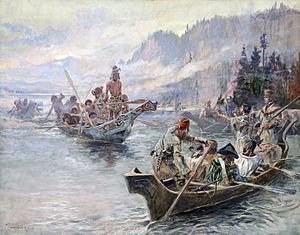
Lewis and Clark Meeting the Salish in Ross Pigsty, September four, 1805.
They followed the Missouri to its headwaters, and over the Continental Separate at Lemhi Pass. In canoes, they descended the mountains by the Clearwater River, the Ophidian River, and the Columbia River, past Celilo Falls, and past what is now Portland, Oregon, at the meeting of the Willamette and Columbia Rivers. Lewis and Clark used William Robert Broughton'due south 1792 notes and maps to orient themselves in one case they reached the lower Columbia River. The sighting of Mountain Hood and other stratovolcanos confirmed that the expedition had almost reached the Pacific Bounding main.[61]
Pacific Ocean

Fort Clatsop reconstruction on the Columbia River near the Pacific Ocean
The expedition sighted the Pacific Ocean for the first time on November 7, 1805, arriving 2 weeks later.[62] [63] The expedition faced its 2nd biting winter camped on the north side of the Columbia River, in a storm-wracked expanse.[62] Lack of food was a major factor. The elk, the political party'south main source of food, had retreated from their usual haunts into the mountains, and the party was now too poor to buy plenty nutrient from neighboring tribes.[64] On November 24, 1805, the political party voted to motion their camp to the south side of the Columbia River near mod Astoria, Oregon. Sacagawea, and Clark's slave York, were both allowed to participate in the vote.[65]
On the south side of the Columbia River, 2 miles (3 km) upstream on the west side of the Netul River (now Lewis and Clark River), they constructed Fort Clatsop.[62] They did this not just for shelter and protection, but as well to officially establish the American presence there, with the American flag flight over the fort.[55] [66] During the winter at Fort Clatsop, Lewis committed himself to writing. He filled many pages of his journals with valuable knowledge, by and large about phytology, because of the abundant growth and forests that covered that part of the continent.[67] The health of the men also became a problem, with many suffering from colds and influenza.[64]
Knowing that maritime fur traders sometimes visited the lower Columbia River, Lewis and Clark repeatedly asked the local Chinooks about trading ships. They learned that Captain Samuel Hill had been there in early on 1805. Miscommunication caused Clark to tape the name as "Haley". Captain Hill returned in November 1805, and anchored about 10 miles (sixteen km) from Fort Clatsop. The Chinook told Hill most Lewis and Clark, but no direct contact was made.[68]
Render trip
Lewis was determined to remain at the fort until April ane, just was notwithstanding broken-hearted to move out at the earliest opportunity. By March 22, the stormy weather had subsided and the following morning, on March 23, 1806, the journey home began. The Corps began their journey homeward using canoes to arise the Columbia River, and later past trekking over land.[69] [70]
Before leaving, Clark gave the Chinook a letter to give to the next ship captain to visit, which was the aforementioned Captain Hill who had been nearby during the winter. Hill took the letter to Canton and had it forwarded to Thomas Jefferson, who thus received it earlier Lewis and Clark returned.[68]
They made their way to Camp Chopunnish[note one] in Idaho, forth the north bank of the Clearwater River, where the members of the trek collected 65 horses in preparation to cross the Bitterroot Mountains, lying between modern-24-hour interval Idaho and western Montana. Even so, the range was still covered in snow, which prevented the trek from making the crossing. On Apr xi, while the Corps was waiting for the snow to diminish, Lewis's dog, Seaman, was stolen by Native Americans, but was retrieved shortly. Worried that other such acts might follow, Lewis warned the chief that any other wrongdoing or mischievous acts would result in instant death.
On July 3, before crossing the Continental Carve up, the Corps carve up into 2 teams then Lewis could explore the Marias River. Lewis's group of four met some men from the Blackfeet nation. During the night, the Blackfeet tried to steal their weapons. In the struggle, the soldiers killed two Blackfeet men. Lewis, George Drouillard, and the Field brothers fled over 100 miles (160 kilometres) in a twenty-four hour period earlier they camped again.
Meanwhile, Clark had entered the Crow tribe's territory. In the dark, half of Clark's horses disappeared, but non a single Crow had been seen. Lewis and Clark stayed separated until they reached the confluence of the Yellowstone and Missouri Rivers on August 11. Every bit the groups reunited, i of Clark's hunters, Pierre Cruzatte, mistook Lewis for an elk and fired, injuring Lewis in the thigh.[71] Once together, the Corps was able to return home quickly via the Missouri River. They reached St. Louis on September 23, 1806.[72]
Spanish interference
In March 1804, before the trek began in May, the Spanish in New United mexican states learned from General James Wilkinson[note 2] that the Americans were encroaching on territory claimed by Spain. Later on the Lewis and Clark trek set up off in May, the Spanish sent four armed expeditions of 52 soldiers, mercenaries[ further explanation needed ], and Native Americans on August i, 1804, from Santa Fe, New Mexico northward under Pedro Vial and José Jarvet to intercept Lewis and Clark and imprison the entire expedition. They reached the Pawnee settlement on the Platte River in cardinal Nebraska and learned that the expedition had been there many days before. The expedition was covering seventy to 80 miles (110 to 130 km) a 24-hour interval and Vial'south endeavor to intercept them was unsuccessful.[73] [74]
Geography and science

Map of Lewis and Clark'southward trek: It inverse mapping of northwest America by providing the first accurate delineation of the human relationship of the sources of the Columbia and Missouri Rivers, and the Rocky Mountains around 1814
The Lewis and Clark Expedition gained an understanding of the geography of the Northwest and produced the outset accurate maps of the area. During the journey, Lewis and Clark drew about 140 maps. Stephen Ambrose says the trek "filled in the main outlines" of the surface area.[75]
The expedition documented natural resources and plants that had been previously unknown to Euro-Americans, though non to the indigenous peoples.[76] Lewis and Clark were the first Americans to cross the Continental Divide, and the get-go Americans to see Yellowstone, enter into Montana, and produce an official description of these different regions.[77] [78] Their visit to the Pacific Northwest, maps, and proclamations of sovereignty with medals and flags were legal steps needed to claim title to each indigenous nation'due south lands nether the Doctrine of Discovery.[79]
The expedition was sponsored past the American Philosophical Social club (APS).[fourscore] Lewis and Clark received some instruction in astronomy, botany, climatology, ethnology, geography, meteorology, mineralogy, ornithology, and zoology.[81] During the expedition, they fabricated contact with over 70 Native American tribes and described more than 200 new found and brute species.[82]
Jefferson had the trek declare "sovereignty" and demonstrate their military machine force to ensure native tribes would be subordinate to the U.S., equally European colonizers did elsewhere. After the expedition, the maps that were produced allowed the farther discovery and settlement of this vast territory in the years that followed.[83] [84]
In 1807, Patrick Gass, a private in the U.South. Army, published an account of the journey. He was promoted to sergeant during the course of the expedition.[85] Paul Allen edited a two-volume history of the Lewis and Clark expedition that was published in 1814, in Philadelphia, but without mention of the actual writer, banker Nicholas Biddle.[86] Even and so, the complete report was not made public until more recently.[87] The earliest authorized edition of the Lewis and Clark journals resides in the Maureen and Mike Mansfield Library at the Academy of Montana.
Encounters with Native Americans
One of the trek's primary objectives as directed by President Jefferson was to be a surveillance mission that would study back the whereabouts, military machine strength, lives, activities, and cultures of the various Native American tribes that inhabited the territory newly caused by the The states as part of the Louisiana Buy and the northwest in general. The expedition was to brand native people understand that their lands now belonged to the United States and that "their swell father" in Washington was now their sovereign.[88] The expedition encountered many different native nations and tribes forth the fashion, many of whom offered their assistance, providing the trek with their cognition of the wilderness and with the acquisition of food. The expedition had blank leather-bound journals and ink for the purpose of recording such encounters, as well as for scientific and geological information. They were also provided with diverse gifts of medals, ribbons, needles, mirrors, and other articles which were intended to ease any tensions when negotiating their passage with the various Indian chiefs whom they would encounter forth their way.[89] [xc] [91] [92]
Many of the tribes had friendly experiences with British and French fur traders in various isolated encounters along the Missouri and Columbia Rivers, and for the most part the trek did not meet hostilities. Still, at that place was a tense confrontation on September 25, 1804, with the Teton-Sioux tribe (besides known as the Lakota people, one of the three tribes that comprise the Great Sioux Nation), under chiefs that included Black Buffalo and the Partisan. These chiefs confronted the trek and demanded tribute from the expedition for their passage over the river.[89] [xc] [91] [92] The seven native tribes that comprised the Lakota people controlled a vast inland empire and expected gifts from strangers who wished to navigate their rivers or to laissez passer through their lands.[93] According to Harry Due west. Fritz, "All earlier Missouri River travelers had warned of this powerful and ambitious tribe, adamant to block free trade on the river. ... The Sioux were likewise expecting a retaliatory raid from the Omaha Indians, to the south. A recent Sioux raid had killed 75 Omaha men, burned 40 lodges, and taken four dozen prisoners."[94]
Captain Lewis made his first mistake by offering the Sioux chief gifts kickoff, which insulted and angered the Partisan chief. Communication was difficult, since the trek's but Sioux language interpreter was Pierre Dorion who had stayed behind with the other party and was besides involved with diplomatic diplomacy with another tribe. Consequently, both chiefs were offered a few gifts, but neither was satisfied and they wanted some gifts for their warriors and tribe. At that indicate, some of the warriors from the Partisan tribe took concur of their gunkhole and ane of the oars. Lewis took a house stand, ordering a display of force and presenting arms; Helm Clark brandished his sword and threatened violent reprisal. Just before the situation erupted into a violent confrontation, Black Buffalo ordered his warriors to dorsum off.[89] [90] [91] [92]
The captains were able to negotiate their passage without further incident with the aid of better gifts and a canteen of whiskey. During the next two days, the trek made camp non far from Black Buffalo's tribe. Similar incidents occurred when they tried to exit, but problem was averted with gifts of tobacco.[89] [90] [91] [92]
Observations
As the expedition encountered the various Native American tribes during the course of their journey, they observed and recorded information regarding their lifestyles, community and the social codes they lived by, as directed by President Jefferson. By European standards, the Native American way of life seemed harsh and unforgiving as witnessed by members of the expedition. Later on many encounters and camping in close proximity to the Native American nations for extended periods of time during the wintertime months, they shortly learned first hand of their community and social orders.
Ane of the primary customs that distinguished Native American cultures from those of the W was that it was customary for the men to take on 2 or more than wives if they were able to provide for them and oft took on a wife or wives who were members of the immediate family unit circle, e.g. men in the Minnetaree [notation 3] and Mandan tribes would often accept on a sister for a wife. Guiltlessness amid women was not held in loftier regard. Infant daughters were often sold by the male parent to men who were grown, usually for horses or mules.[ citation needed ]
They learned that women in Sioux nations were often bartered away for horses or other supplies, notwithstanding this was not skillful among the Shoshone nation who held their women in higher regard.[95] They witnessed that many of the Native American nations were constantly at state of war with other tribes, particularly the Sioux, who, while remaining mostly friendly to the white fur traders, had proudly boasted of and justified the nearly complete destruction of the once nifty Cahokia nation, along with the Missouris, Illinois, Kaskaskia, and Piorias tribes that lived about the countryside adjacent to the upper Mississippi and Missouri rivers.[96]
Sacagawea

Statue of Sacagawea, a Shoshone adult female who accompanied the Lewis and Clark Trek
Sacagawea, sometimes spelled Sakajawea or Sakagawea (c. 1788 – December 20, 1812), was a Shoshone Native American woman who arrived with her married man and owner Toussaint Charbonneau on the expedition to the Pacific Sea.
On February xi, 1805, a few weeks subsequently her start contact with the trek, Sacagawea went into labor which was slow and painful, and then the Frenchman Charbonneau suggested she be given a potion of rattlesnake's rattle to aid in her delivery. Lewis happened to accept some snake's rattle with him. A short time after administering the potion, she delivered a healthy boy who was given the name Jean Baptiste Charbonneau.[97] [98]
When the trek reached Marias River, on June sixteen, 1805, Sacagawea became dangerously ill. She was able to find some relief past drinking mineral water from the sulphur bound that fed into the river.[99]
Though she has been discussed in literature ofttimes, much of the information is exaggeration or fiction. Scholars say she did notice some geographical features, but "Sacagawea ... was non the guide for the Trek, she was of import to them every bit an interpreter and in other means."[100] The sight of a woman and her infant son would take been reassuring to some indigenous nations, and she played an of import role in diplomatic relations past talking to chiefs, easing tensions, and giving the impression of a peaceful mission.[101] [102]
In his writings, Meriwether Lewis presented a somewhat negative view of her, though Clark had a higher regard for her, and provided some support for her children in subsequent years. In the journals, they used the terms "squar" (squaw) and "savages" to refer to Sacagawea and other indigenous peoples.[103]
York
An enslaved black homo known only as York took part in the trek as personal servant to William Clark, his possessor. York did much to aid the trek succeed. He proved popular with the Native Americans, who had never seen a black man. He also helped with hunting and the heavy labor of pulling boats upstream. Expecting his freedom afterward the expedition, he was disappointed when Clark refused repeatedly. While all the other explorers enjoyed rewards of double pay and country, York received zippo. Clark would not allow York to remain in Louisville with his wife and probably children. He whipped York, put him in jail, and eventually sold him. The last years of York's life are disputed. In the 1830s, a black human being who said he had get-go come with Lewis & Clark was living as a main with Indians they met on the expedition, in modern Wyoming.
Accomplishments
The Corps met their objective of reaching the Pacific, mapping and establishing their presence for a legal merits to the state. They established diplomatic relations and trade with at least two dozen indigenous nations. They did not detect a continuous waterway to the Pacific Ocean[104] but located an Indian trail that led from the upper end of the Missouri River to the Columbia River which ran to the Pacific Bounding main.[105] They gained information about the natural habitat, flora and fauna, bringing back various constitute, seed and mineral specimens. They mapped the topography of the country, designating the location of mount ranges, rivers and the many Native American tribes during the course of their journey. They also learned and recorded much nearly the language and customs of the Indian tribes they encountered, and brought back many of their artifacts, including bows, habiliment and formalism robes.[106]
Backwash
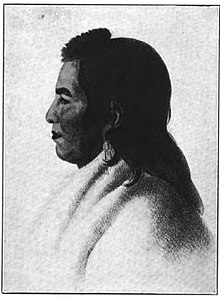
Painting of Mandan Chief Big White, who accompanied Lewis and Clark on their return from the expedition
Two months passed after the expedition's end earlier Jefferson made his start public statement to Congress and others, giving a one-sentence summary near the success of the expedition before getting into the justification for the expenses involved. In the class of their journeying, they caused a knowledge of numerous tribes of Native Americans hitherto unknown; they informed themselves of the merchandise which may exist carried on with them, the all-time channels and positions for information technology, and they are enabled to give with accuracy the geography of the line they pursued. Back east, the botanical and zoological discoveries drew the intense involvement of the American Philosophical Society who requested specimens, various artifacts traded with the Native Americans, and reports on plants and wildlife along with various seeds obtained. Jefferson used seeds from "Missouri hominy corn" forth with a number of other unidentified seeds to plant at Monticello which he cultivated and studied. He after reported on the "Indian corn" he had grown as being an "excellent" food source.[107] The expedition helped found the U.S. presence in the newly caused territory and beyond and opened the door to further exploration, trade and scientific discoveries.[108]
Lewis and Clark returned from their expedition, bringing with them the Mandan Native American Chief Shehaka from the Upper Missouri to visit the "Great Father" in Washington. Afterward Chief Shehaka's visit, it required multiple attempts and multiple armed services expeditions to safely return Shehaka to his nation.
Legacy and honors
In the 1970s, the federal regime memorialized the wintertime assembly encampment, Camp Dubois, as the start of the Lewis and Clark voyage of discovery and in 2022 it recognized Pittsburgh, Pennsylvania as the commencement of the trek.[109]
Since the expedition, Lewis and Clark have been commemorated and honored over the years on various coins, currency, and commemorative postage stamp stamps, as well equally in a number of other capacities. In 2004, the American elm cultivar Ulmus americana 'Lewis & Clark' (selling name Prairie Expedition) was released by North Dakota State University Research Foundation in celebration of the trek's bicentenary;[110] the tree has a resistance to Dutch elm disease.
The Lewis and Clark Public School District in North Dakota is named after the pair.
-

Lewis and Clark Trek, 2004
200th Ceremony issue U.S. postage stamp commemorating the 200th anniversary of the Trek -

Lewis and Clark Expedition
150th anniversary outcome, 1954 -
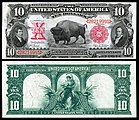
Lewis & Clark were honored (forth with the American bison) on the Serial of 1901 $10 Legal Tender
-

Lewis and Clark Mosaic epitome in Missouri
Prior discoveries
In 1682, René-Robert Cavelier, Sieur de La Salle traveled down the Mississippi from the Great Lakes to the Gulf. The French then established a chain of posts forth the Mississippi from New Orleans to the Great Lakes. There followed a number of French explorers including Pedro Vial and Pierre Antoine and Paul Mallet, among others. Vial may have preceded Lewis and Clark to Montana. In 1787, he gave a map of the upper Missouri River and locations of "territories transited by Pedro Vial" to Spanish authorities.[111]
Early on in 1792, the American explorer Robert Grey, sailing in the Columbia Rediviva, discovered the yet to be named Columbia River, named it later his send and claimed it for the The states. Afterward in 1792, the Vancouver Trek had learned of Gray'southward discovery and used his maps. Vancouver's trek explored over 100 miles (160 km) up the Columbia, into the Columbia River Gorge. Lewis and Clark used the maps produced past these expeditions when they descended the lower Columbia to the Pacific declension.[112] [113]
From 1792 to 1793, Alexander Mackenzie had crossed Northward America from Quebec to the Pacific.[114]
Run across besides
- Timeline of the Lewis and Clark Expedition
- The Far Horizons, a movie about the expedition
- Gateway Arch National Park
- Lewis and Clark Pass (Montana) – the simply non-motorized pass on the expedition'south route
- Lewis and Clark's Keelboat
- The Carmine River Expedition (1806) and the Pike Expedition were likewise commissioned by Jefferson
- James Kendall Hosmer American history professor and librarian who edited and published Nicholas Biddle's business relationship of Lewis and Clark's periodical
Notes
- ^ 'Chopunnish' was the Captain'south term for the Nez Perce Pass
- ^ After Wilkinson died in 1825, it was discovered that he was a spy for the Spanish crown.
- ^ aka the Hidatsa
References
- ^ Woodger, Toropov, 2009 p. 150
- ^ Ambrose, 1996, Chap. VI
- ^ Miller, 2006 p. 108
- ^ Fenelon & Wilson, 2006 pp. 90–91
- ^ a b Lavender, 2001 pp.32, xc
- ^ Ronda, 1984 pp. 82, 192
- ^ Fritz, 2004 p. 113
- ^ Ronda, 1984 p. 9
- ^ a b c Ronda, 1984 pp. 327–28
- ^ a b Fresonke & Spence, 2004 pp. 159–62
- ^ Moulton, 2004
- ^ Ambrose, 1996 p. 480
- ^ Saindon, 2003 pp. six, 1040
- ^ Ambrose, 1996 p. 69
- ^ Gray, 2004 p. 358
- ^ DeVoto, 1997 p. xxix
- ^ Schwantes, 1996 pp. 54–55
- ^ Cutright 1969, p. 27.
- ^ Rodriguez, 2002 p. xxiv
- ^ Furtwangler, 1993 p. 19
- ^ Ambrose, 1996 p. 83
- ^ Bergon, 2003, p. xiv
- ^ Jackson, 1993, pp. 136–137
- ^ Ambrose, pp. 98-99
- ^ Woodger & Toropov, 2009 p. 270
- ^ "Lewis and Clark Expedition". Archived from the original on December 8, 2015. Retrieved November 30, 2015.
- ^ "Founders Online: From Thomas Jefferson to Benjamin Smith Barton, 27 February 1803". founders.athenaeum.gov. Archived from the original on April 12, 2019. Retrieved April 12, 2019.
- ^ Gass & MacGregor, 1807 p. 7
- ^ Ambrose, 1996 pp. 79, 89
- ^ Duncan, Dayton; Burns, Ken (1997). Lewis & Clark: The Journey of the Corps of Discovery. New York: Alfred A. Knopf, Inc. pp. 9–10. ISBN9780679454502.
- ^ Ambrose, Stephen (1996). Undaunted Courage: Meriwether Lewis, Thomas Jefferson, and the Opening of the American West. New York: Simon & Schuster. pp. 81, 87–91. ISBN9780684826974.
- ^ Jackson, 1993, pp.86–87
- ^ Ambrose, 1996 p. thirteen
- ^ Homser, James Kendall, 1903 p. 1
- ^ Kleber, 2001 pp. 509–x
- ^ Fritz, 2004 pp. ane–5
- ^ Ronda, 1984 p. 32
- ^ Miller, 2006 pp. 99–100, 111
- ^ Bennett, 2002 p. 4
- ^ Ambrose, 1996 p. 94
- ^ a b Saindon, 2003 pp. 551–52
- ^ a b Miller, 2006 p. 106
- ^ Woodger, Toropov, 2009 pp. 104, 265, 271
- ^ Lavander, 2001 pp. thirty–31
- ^ Ambrose, 1996 pp. 137-139
- ^ "May fourteen, 1804 | Discovering Lewis & Clark ®". www.lewis-clark.org. Archived from the original on March 20, 2020. Retrieved March 20, 2020.
- ^ Peters 1996, p. 16.
- ^ Allen, Lewis & Clark, Vol. i, 1916 pp. 26–27
- ^ Woodger & Toropov, 2009 p. 142
- ^ Coues, Lewis, Clark, Jefferson 1893, Vol. 1 p. 79
- ^ Fritz, 2004 p. 13
- ^ Fritz, 2004 p. fourteen
- ^ "Bad River Encounter Site (U.S. National Park Service)". www.nps.gov. Archived from the original on Baronial 3, 2020. Retrieved May xviii, 2020.
- ^ Fritz, 2004 pp. xiv–15
- ^ a b Ambrose, 1996 p. 170
- ^ Ronda, 1984 pp. 27, 40
- ^ Lavender, 2001 p. 181
- ^ Peters 1996, pp. twenty–22.
- ^ Clark & Edmonds, 1983 p. 12
- ^ Allen, Lewis & Clark, Vol. 1, 1916 pp. 81–82
- ^ Elin Woodger; Brandon Toropov (2009). Encyclopedia of the Lewis and Clark Expedition. Infobase Publishing. pp. 244–45. ISBN978-1-4381-1023-3 . Retrieved August 28, 2013.
- ^ a b c Lewis, Mailing Address; Astoria, Clark National Historical Park 92343 Fort Clatsop Road; United states of america, OR 97103 Telephone:861-2471 Contact. "History & Civilisation - Lewis and Clark National Historical Park (U.Due south. National Park Service)". www.nps.gov. Archived from the original on February 22, 2015. Retrieved June 23, 2020.
- ^ "Lewis and Clark, Journeying Leg 13, 'Ocian in View!', October 8 – December 7, 1805". National Geographic Society. 1996. Archived from the original on September 27, 2016. Retrieved October 22, 2016.
- ^ a b Ambrose, 1996 p. 326
- ^ Clark & Edmonds, 1983 pp. 51–52
- ^ Harris, Buckley, 2012, p. 109
- ^ Ambrose, 1996 p. 330
- ^ a b Malloy, Mary (2006). Devil on the deep blue body of water: The notorious career of Helm Samuel Hill of Boston. Bullbrier Printing. pp. vii, 46–49, 56, 63–64. ISBN978-0-9722854-1-four.
- ^ Ambrose, 1996 p. 334
- ^ Coues, Lewis, Clark, Jefferson 1893 pp. 902–04
- ^ "Meriwether Lewis is shot in the leg". History. A&E Idiot box Networks. Archived from the original on October fifteen, 2018. Retrieved October 14, 2018.
- ^ Peters 1996, p. thirty.
- ^ Uldrich, 2004 p. 82
- ^ Ambrose, 1996 p. 402
- ^ Ambrose, 1996 p. 483
- ^ Fritz, 2004 p. 60
- ^ Ambrose, 1996 p. 409
- ^ Woodger & Toropov, 2009 p. 99
- ^ DeVoto, 1997 p. 552
- ^ Woodger, Toropov, 2012 p. 29
- ^ Fritz, 2004 p. 59
- ^ Uldrich, 2004 p. 37
- ^ Fresonke & Spence, 2004 p. 70
- ^ Fritz, 2004 p. 88
- ^ Gass & MacGregor, 1807 pp. four, 3
- ^ Ambrose, 1996 pp. 479–80
- ^ Lewis and Clark Journals Archived January 30, 2009, at the Wayback Car
- ^ Pekka Hamalainen, "Lakota America, a New History of Indigenous Power," (New Haven: Yale University Press, 2019), pp. 129-131
- ^ a b c d Josephy, 2006 p. 6
- ^ a b c d Allen, Lewis & Clark, Vol. 1, 1916 p. 52
- ^ a b c d Ambrose, 1996 p. 169
- ^ a b c d Woodger & Toropov, 2009 pp. 8, 337–38
- ^ Pekka Hamalainen, "Lakota America, a New History of Ethnic Ability," (New Haven: Yale University Printing, 2019), pp. 130-136
- ^ Harry Westward. Fritz (2004). "The Lewis and Clark Expedition". Greenwood Publishing Group. p.14. ISBN 0313316619
- ^ Coues, Lewis, Clark, Jefferson 1893, Vol. 2 pp. 557–58
- ^ Lewis, Clark Floyd, Whitehouse, 1905 p. 93
- ^ Coues, Lewis, Clark, Jefferson 1893, Vol. 1 p. 229
- ^ Clark & Edmonds, 1983 p. 15
- ^ Coues, Lewis, Clark, Jefferson 1893, Vol. i p. 377
- ^ Clark & Edmonds, 1983 p. 16
- ^ Fritz, 2004 p. xix
- ^ Clark & Edmonds, 1983 pp. 16, 27
- ^ Ronda, 1984 pp. 258–59
- ^ Fritz, 2004 pp. 33–35
- ^ Ambrose, 1996 pp. 352, 407
- ^ Ambrose, 1996 p. 204
- ^ Ambrose, 1996, p. 418
- ^ Ambrose, 1996, p. 144
- ^ Bauder, Bob (March 10, 2019). "Pittsburgh recognized equally starting point for Lewis and Clark expedition". Pittsburgh Tribune-Review . Retrieved March 10, 2019.
- ^ "Ulmus americana 'Lewis & Clark' PRAIRIE EXPEDITION". Institute Finder. Archived from the original on Baronial 15, 2021. Retrieved Baronial xv, 2021.
- ^ Loomis & Nasatir 1967 pp. 382–86, map: p. 290
- ^ Ambrose, 1996 p. 70, 91
- ^ Woodger, Toropov, 2009 pp. 191, 351
- ^ "Sir Alexander Mackenzie | Scottish explorer". Encyclopedia Britannica. Archived from the original on June 15, 2020. Retrieved June 23, 2020.
Bibliography
- Allen, Paul (1902). History of the trek nether the command of Captains Lewis and Clark, Vol I. Toranto, George North. Morang & Co. Ltd.
- —— (1902). History of the trek under the control of Captains Lewis and Clark, Vol 2. Toranto, George N. Morang & Co. Ltd.
- —— (1902). History of the expedition under the command of Captains Lewis and Clark, Vol III. Toranto, George North. Morang & Co. Ltd.
- Ambrose, Stephen East. (1996). Undaunted Backbone: Meriwether Lewis, Thomas Jefferson, and the Opening of the American West . Simon and Schuster, New York. p. 511. ISBN9780684811079.
- Bennett, George D. (2002). The U.s. Army: Issues, Groundwork and Bibliography. Nova Publishers. p. 229. ISBN9781590333006.
- Bergon, Frank (1989). The Journals of Lewis and Clark. Penguin Classics, New York. ISBN0142437360.
- Clark, Ella E.; Edmonds, Margot (1983). Sacagawea of the Lewis and Clark Expedition. University of California Printing. p. 184. ISBN9780520050600.
- Cutright, Paul Russel (1969). Lewis and Clark: Pioneering Naturalists. University of Nebraska Press.
- Cutright, Paul Russell (2000). Contributions of Philadelphia to Lewis and Clark History. Lewis and Clark Trail Heritage Foundation. p. 47. ISBN9780967888705.
- DeVoto, Bernard Augustine (1997) [1953]. The Journals of Lewis and Clark. Houghton Mifflin Company. p. 504. ISBN0-395-08380-Ten.
- —— (1998). The Class of Empire. Houghton Mifflin Harcourt. p. 647. ISBN9780395924983.
- Fenelon, James; Defender-Wilson, Mary Louise (1985). "Voyage of Domination, "Purchase" every bit Conquest, Sakakawea for Savagery: Distorted Icons from Misrepresentations of the Lewis and Clark Trek". Wicazo Sa Review. University of Minnesota Press. 19 (ane): Wicazo Sa Review, 85–104. doi:ten.1353/wic.2004.0006. JSTOR 1409488. S2CID 147041160.
- Fresonke, Kris; Spence, Marking (2004). Lewis and Clark. University of California Press. p. 290. ISBN9780520228399.
- Fritz, Harry Westward. (2004). The Lewis and Clark Expedition . Greenwood Publishing Group. p. 143. ISBN978-0-313-31661-6.
- Furtwangler, Albert (1993). Acts of discovery: visions of America in the Lewis and Clark journals . University of Illinois Press. ISBN978-0-252-06306-0.
- Gass, Patrick; MacGregor, Carol Lynn (1807). The Journals of Patrick Gass: Member of the Lewis and Clark Expedition. Mountain Press Publishing. p. 447. ISBN9780878423514.
- Gray, Edward (2004). "Visions of Some other Empire: John Ledyard, an American Traveler across the Russian Empire, 1787–1788". Journal of the Early Republic. University of Pennsylvania Press. 24 (3): 347–380. JSTOR 4141438.
- Harris, Matthew Fifty.; Buckley, Jay H. (2012). Zebulon Thruway, Thomas Jefferson, and the Opening of the American Westward. Academy of Oklahoma Printing, 256 pages. ISBN9780806188317.
- Josephy, Alvin Yard. Jr.; Marc, Jaffe, eds. (2006). Lewis and Clark Through Indian Eyes. Random Business firm Digital, Inc. p. 196. ISBN9781400042678.
- Jackson, Donald (1993) [1981]. Thomas Jefferson & the Stony Mountains: Exploring the West from Monticello. University of Oklahoma Press. ISBN978-0-8061-2504-6.
- Kleber, John (2001). The Encyclopedia of Louisville. University Press of Kentucky. p. 509. ISBN978-0-8131-2100-0.
- Lavender, David Sievert (2001). The Mode to the Western Sea: Lewis and Clark Beyond the Continent. Academy of Nebraska Press. p. 444. ISBN9780803280038.
- Loomis, Noel M; Nasatir, Abraham P (1967). Pedro Vial and the Roads to Santa Atomic number 26. University of Oklahoma Printing. ISBN9780806111100.
- Miller, Robert J. Miller (2006). Native America, Discovered And Conquered: Thomas Jefferson, Lewis & Clark, And Manifest Destiny. Greenwood Publishing Group. p. 240. ISBN9780275990114.
- Peters, Arthur 1000. (1996). Seven trail west. Abbeville Printing. ISBN1-55859-782-4.
- Saindon, Robert A. (2003). Explorations Into the World of Lewis and Clark, Volume 3. Digital Scanning Inc. p. 528. ISBN9781582187655.
- Schwantes, Carlos (1996). The Pacific Northwest: an interpretive history. University of Nebraska Press. p. 568. ISBN978-0-8032-9228-4.
- Rodriguez, Junius (2002). The Louisiana Purchase: a historical and geographical encyclopedia. ABC-CLIO, Santa Barbara, California. p. 513. ISBN978-1-57607-188-5.
- Ronda, James P. (1984). Lewis & Clark among the Indians. University of Nebraska Printing. p. 310. ISBN9780803289901.
- Uldrich, Jack (2004). Into the unknown: leadership lessons from Lewis & Clark's daring westward adventure. AMACOM Div American Mgmt Assn. p. 245. ISBN0-8144-0816-viii.
- Woodger, Elin; Toropov, Brandon (2009). Encyclopedia of the Lewis and Clark Expedition. Infobase Publishing. p. 438. ISBN978-0-8160-4781-9.
Master sources
- Lewis, Meriwether; Clark, William (2004). The Journals Of Lewis And Clark. Kessinger Publishing. p. 312. ISBN9781419167997. East'books, Full view[ full citation needed ]
- Lewis, Meriwether; Clark, William; Floyd, Charles; Whitehouse, Joseph (1905). Original Journals of the Lewis and Clark Expedition, 1804-1806, V.6. Dodd, Mead & Company, New York. p. 280.
- Lewis, Meriwether; Clark, William (2003). Bergon, Frank (ed.). The Journals of Lewis & Clark. Penguin. p. 560. ISBN9780142437360.
- Lewis, Meriwether; Clark, William (1815). Travels to the source of the Missouri river and beyond the American continent to the Pacific ocean. Performed by lodge of the government of the United States, in the years 1804, 1805, and 1806. By Captains Lewis and Clarke. Published from the official report, and illustrated by a map of the road, and other maps. London: Longman, Hurst, Rees, Orme & Chocolate-brown.
- "Review of Travels to the Source of the Missouri River ... ". The Quarterly Review. 12: 317–368. Jan 1815.
- Lewis, William; Clark, Clark (1903). Hosmer, James Kendall (ed.). History of the Expedition of Helm Lewis and Clark, 1804-5-vi, Volume ane. A. C. McClurg & Company, Chicago. p. 500.
- Coues, Elliott; Lewis, Meriwether; Clark, William; Jefferson, Thomas (1893). History of the expedition under the command of Lewis and Clark: Volume 1. Francis P. Harper, New York. p. 1364.
- ——; Lewis, Meriwether; Clark, William; Jefferson, Thomas (1893). History of the expedition under the command of Lewis and Clark: Volume ii. Francis P. Harper, New York. p. 1364.
- ——; Lewis, Meriwether; Clark, William; Jefferson, Thomas (1893). History of the expedition under the command of Lewis and Clark: Volume 3. Francis P. Harper, New York. p. 1298.
- ——; Lewis, Meriwether; Clark, William; Jefferson, Thomas (1893). History of the expedition under the control of Lewis and Clark: Book 4. Francis P. Harper, New York. p. 1298.
- Jackson, Donald Dean (1962). Letters of the Lewis and Clark Expedition: with related documents, 1783-1854 . University of Illinois Printing (Original from the University of Virginia). p. 728.
- Lewis, Meriwether; Clark, William (2004). Moulton, Gary E. (ed.). The Definitive Journals of Lewis & Clark. Academy of Nebraska Press. p. 357. ISBN9780803280328.
Further reading
- Steven Due east. Ambrose (1996). Undaunted Backbone, Meriwether Lewis, Thomas Jefferson, and the Opening of the American Due west . Simon and Schuster Paperbacks.
- Bassman, John H. (2009). A Navigation Companion for the Lewis & Clark Trail. Volume 1, History, army camp locations and daily summaries of expedition activities. John H. Bassman.
- Betts, Robert B. (2002). In Search of York: The Slave Who Went to the Pacific With Lewis and Clark. ISBN0-87081-714-0.
- Clark, William; Lewis, Meriwether. The Journals of Lewis and Clark, 1804–1806.
- Burns, Ken (1997). Lewis & Clark: The Journeying of the Corps of Discovery. ISBN0-679-45450-0.
- Fenster, Julie Thousand. (2016). Jefferson'south America: The President, the Purchase, and the Explorers Who Transformed a Nation. Crown/Archetype. ISBN978-0-3079-5654-5.
- Hayes, Derek (1999). Historical Atlas of the Pacific Northwest: Maps of Exploration and Discovery: British Columbia, Washington, Oregon, Alaska, Yukon. Sasquatch Books. p. 208. ISBN978-1570612152.
- Gen. Thomas James. Three Years Amidst the Indians and Mexicans. ISBN978-1985208711.
- Gilman, Carolyn (2003). Lewis and Clark: Across the Divide. Washington, D.C.: Smithsonian Books. ISBN978-1588340993.
- Schmidt, Thomas (2002). National Geographic Guide to the Lewis & Clark Trail. ISBN0-7922-6471-1.
- Tubbs, Stephenie Ambrose (2008). Why Sacagawea Deserves the Solar day Off and Other Lessons from the Lewis and Clark Trail. University of Nebraska Press.
- Wheeler, Olin Dunbar (1904). The Trail of Lewis and Clark, 1804–1904: A Story of the Nifty Exploration Across the Continent in 1804–6. New York: G.P. Putnam's Sons. p. 377.
External links
- Full text of the Lewis and Clark journals online – edited by Gary E. Moulton, University of Nebraska–Lincoln
- "National Archives photos dating from the 1860s–1890s of the Native cultures the expedition encountered". Archived from the original on February 12, 2008.
- Travel the Lewis and Clark Expedition, a National Park Service Notice Our Shared Heritage Travel Itinerary
- "History of the Expedition Under the Command of Captains Lewis and Clark: To the Sources of the Missouri, thence Across the Rocky Mountains and down the River Columbia to the Pacific Ocean" published in 1814; from the World Digital Library
- Lewis & Clark Fort Mandan Foundation: Discovering Lewis & Clark
- Corps of Discovery Online Atlas, created by Watzek Library, Lewis & Clark College
- Lewis and Clark Trek Maps and Receipt. Yale Collection of Western Americana, Beinecke Rare Book and Manuscript Library.
- William Clark Field Notes. Yale Collection of Western Americana, Beinecke Rare Book and Manuscript Library.
- Louis Starr Collection Apropos the Field Notes of William Clark. Yale Drove of Western Americana, Beinecke Rare Book and Manuscript Library.
gonzalezuncloyesseen.blogspot.com
Source: https://en.wikipedia.org/wiki/Lewis_and_Clark_Expedition
0 Response to "There and Back Again Lewis and Clark"
Postar um comentário